I would like to talk about an inflection point in social media that requires pause. I am not suggesting that there will be a social media 2.0 or 3.0 for that matter. Nor do I see the term social media departing our vocabulary any time soon. After all, it was recently added to the Merriam-Webster dictionary. Instead, what I would like to discuss is the end of an era of social media that will force the industry to mature. It won’t happen on its own however. Evolution will occur because consumers demand it and also because you’re willing to stake your job on it.
From Social Network Fatigue to Deals Fatigue to Follow Fatigue, businesses are facing a crossroads at the intersection of social and media. Following the path of media continues a long tradition of what Tom Foremski refers to as “Social Media as Corporate Media.” Following the path of social is a journey towards relevance.
As Foremski states, “Social media is not corporate media…if corporations try to turn social media into a corporate sales or marketing channel then they risk losing the naked conversations, and the insight into customer behaviors.”
His point is that there’s more to social media than clever campaigns and rudimentary conversations. Talking isn’t the only thing that makes social media social. Just like adding Facebook, Twitter and other sharing buttons will not magically transform static content into shareable experiences. Listening, learning and adapting is where the real value of social media will show its true colors. Listening leads to a more informed business. Engagement unlocks empathy and innovation. But it is action and adaptation that leads to relevance. And, it never ends.
Indeed, there really are more examples of media than there are that of social media in many of the celebrated examples out there today. Even though distributing corporate media in social channels sets the stage for dialogue, there really isn’t much that’s social about it. In fact, study of many social media initiatives have led me to believe that much of what we benchmark against is actually anti-social in its approach.
The future of social media comes down to one word, “value.” Without it, businesses will find it much more difficult to earn and retain friends, fans and followers (3F’s). As adoption of social networks soared in previous years, growth is now plateauing. eMarketer estimates that Facebook growth will hit only 13.4% this year after experiencing 38.6% acceleration in 2010 and a staggering 90.3% ascension the year before. Facebook isn’t alone in its sobriety either. The rate of Twitter user adoption fell from 293.1% growth in 2009 to 26.3% this year.
Don’t get me wrong, people are still embracing social networks. However, the severity of competition for consumer attention is now unmistakable. Once liberal with their likes, Retweets, and follows, consumers are becoming much more guarded and realistic. Therefore brands will now have to more effectively listen to markets to make more informed decisions about how social media impacts the enterprise and in turn customer experiences.
The GlobalWebIndex “Wave 5 Trends” report delivers insight into how consumers are using social networks and technology in general. According to the report, growth in social network usage among 16- to 24-year-olds in the US is stalling. And, in a few countries usage within this group is declining. In fact, one of the key insights shared in the report is subduing, “Facebook is no longer the one stop shop for the total internet experience.”
However, the report is not a harbinger of social networking’s demise. It is merely a lens into how behavior is changing. This is important for any business to realize that business as usual in social networks is in fact anything but.
Between June 2009 and June 2011, the following changes were noted in Facebook activity:
- Uploading videos is experiencing a modest increase around the world up 5% in the U.S. and 7.6% worldwide.
- Installing apps is on the decline, down 10.4% in the U.S. and 3.1% worldwide.
- Sending virtual gifts may not be gifts worth giving after all, with numbers declining 12.9% in the U.S. and 7.5% around the world.
Twitter on the other hand is a rich exchange for information commerce, where links become a form of digital currency. For example, 45% share an opinion about a product or brand more than once per day. Another 34% of Twitter users also share a link about a product or brand more than once per day.
When asked what consumers want from brands, knowledge and entertainment soared to the top of the list. Additionally, The GlobalWebIndex Wave 5 Trends report tells us that online consumers want brands to provide services that fit with their lifestyle. They also want brands to listen to them.
What can we learn of this?
1) Businesses must first realize that there’s more to social media than just managing an active presence, driven by an active editorial calendar. Listening is key and within each conversation lies a clue to earn relevance and ultimately establish leadership.
2) Consumers want to be heard. Social media will have to break free form the grips of marketing in order to truly socialize the enterprise to listen, engage, learn, and adapt. You can’t create a social business if the business is not designed to be customer-centric from the outside-in and the inside-out.
3) Social media becomes an extension of active listening and engagement. Strategies, programs, and content are derivative of insights, catalysts for innovation, and messengers of value. More importantly, social media becomes a platform for the brand and the functions that consumers deem mandatory. From marketing to HR to service to R&D, brands will expand the role they play in social networking to make the acts of following and sharing an investment in a more meaningful relationship.
The end of Social Media 1.0 is the beginning of a new era of business, consumer engagement, and relevance.
8/30/2011


6/21/2011
ICANN Approves Historic Change to Internet's Domain Name System Board Votes to Launch New Generic Top-Level Domains
ICANN's Board of Directors has approved a plan to usher in one of the biggest changes ever to the Internet's Domain Name System. The Board vote was 13 approving, 1 opposed, and 2 abstaining.
During a special meeting, the Board approved a plan to dramatically increase the number of Internet domain name endings -- called generic top-level domains (gTLDs) -- from the current 22, which includes such familiar domains as .com, .org and .net.
"ICANN has opened the Internet's naming system to unleash the global human imagination. Today's decision respects the rights of groups to create new Top Level Domains in any language or script. We hope this allows the domain name system to better serve all of mankind," said Rod Beckstrom, President and Chief Executive Officer of ICANN.
New gTLDs will change the way people find information on the Internet and how businesses plan and structure their online presence. Internet address names will be able to end with almost any word in any language, offering organizations around the world the opportunity to market their brand, products, community or cause in new and innovative ways.
"Today's decision will usher in a new Internet age," said Peter Dengate Thrush, Chairman of ICANN's Board of Directors. "We have provided a platform for the next generation of creativity and inspiration."
The decision to proceed with the gTLD program follows many years of discussion, debate and deliberation with the Internet community, business groups and governments. The Applicant Guidebook, a rulebook explaining how to apply for a new gTLD, went through seven significant revisions to incorporate more than 1,000 comments from the public. Strong efforts were made to address the concerns of all interested parties, and to ensure that the security, stability and resiliency of the Internet are not compromised.
ICANN will soon begin a global campaign to tell the world about this dramatic change in Internet names and to raise awareness of the opportunities afforded by new gTLDs. Applications for new gTLDs will be accepted from 12 January 2012 to 12 April 2012.
Journalist and media expert Oksana Prykhodko arrived at ICANN 40 in San Francisco with a mission. She had set out to improve understanding in Ukraine of the importance of the Internet.
Oksana characterizes the week that followed as "great, wonderful, and a little crazy." She found an ally in the manager of the Russian country code top level domain, and gained insight into Internationalized Domain Names (IDNs). Attending her first ICANN meeting as a Fellow, Oksana found the experience rewarding – and three short months later, has been elected Secretariat of the European Regional At-Large Organization (EURALO). She also has joined the Working Group for Cyrillic IDNs.
Can participating in ICANN's volunteer community accelerate your Internet agenda? Quite possibly. Listen to Oksana's video. Then, if you're from a developing country, consider applying to ICANN's Fellowship Program to attend a future ICANN meeting with some travel expenses covered.
The application round for attending our October meeting in Dakar, Senegal, as a Fellow is open until 8 July 2011.
Friendly, outgoing, and technologically savvy, Fouad Bajwa was the State Webmaster for the government of Pakistan. When he returned to private sector employment, he thirsted for technical knowledge that could keep him relevant in the international market as he promoted the open-source movement.
Despite strong doubts regarding ICANN's model and motives, Fouad attended our meeting in Seoul, South Korea, in 2009. Today, he volunteers as the co-Vice Chair for the Asian-Pacific Regional At-Large Organization (APRALO), a key part of ICANN's At-Large community.
What changed Fouad's opinion of ICANN? And how has working with ICANN helped this accomplished IT trainer? Hear Fouad's story, in his own words, in the accompanying video.
This video continues the "Who Is ICANN?" series we launched last week. Part One introduced Mistura Aruna of Nigeria.
Fouad attended his first ICANN meeting courtesy of the Fellowship Program. If you're from a developing country, you can learn more about the Program on our ICANN Meeting Fellowships page. Apply now to attend our October meeting in Dakar, Senegal, as a Fellow. The deadline for applying is 8 July 2011.
During a special meeting, the Board approved a plan to dramatically increase the number of Internet domain name endings -- called generic top-level domains (gTLDs) -- from the current 22, which includes such familiar domains as .com, .org and .net.
"ICANN has opened the Internet's naming system to unleash the global human imagination. Today's decision respects the rights of groups to create new Top Level Domains in any language or script. We hope this allows the domain name system to better serve all of mankind," said Rod Beckstrom, President and Chief Executive Officer of ICANN.
New gTLDs will change the way people find information on the Internet and how businesses plan and structure their online presence. Internet address names will be able to end with almost any word in any language, offering organizations around the world the opportunity to market their brand, products, community or cause in new and innovative ways.
"Today's decision will usher in a new Internet age," said Peter Dengate Thrush, Chairman of ICANN's Board of Directors. "We have provided a platform for the next generation of creativity and inspiration."
The decision to proceed with the gTLD program follows many years of discussion, debate and deliberation with the Internet community, business groups and governments. The Applicant Guidebook, a rulebook explaining how to apply for a new gTLD, went through seven significant revisions to incorporate more than 1,000 comments from the public. Strong efforts were made to address the concerns of all interested parties, and to ensure that the security, stability and resiliency of the Internet are not compromised.
ICANN will soon begin a global campaign to tell the world about this dramatic change in Internet names and to raise awareness of the opportunities afforded by new gTLDs. Applications for new gTLDs will be accepted from 12 January 2012 to 12 April 2012.
Journalist and media expert Oksana Prykhodko arrived at ICANN 40 in San Francisco with a mission. She had set out to improve understanding in Ukraine of the importance of the Internet.
Oksana characterizes the week that followed as "great, wonderful, and a little crazy." She found an ally in the manager of the Russian country code top level domain, and gained insight into Internationalized Domain Names (IDNs). Attending her first ICANN meeting as a Fellow, Oksana found the experience rewarding – and three short months later, has been elected Secretariat of the European Regional At-Large Organization (EURALO). She also has joined the Working Group for Cyrillic IDNs.
Can participating in ICANN's volunteer community accelerate your Internet agenda? Quite possibly. Listen to Oksana's video. Then, if you're from a developing country, consider applying to ICANN's Fellowship Program to attend a future ICANN meeting with some travel expenses covered.
The application round for attending our October meeting in Dakar, Senegal, as a Fellow is open until 8 July 2011.
Friendly, outgoing, and technologically savvy, Fouad Bajwa was the State Webmaster for the government of Pakistan. When he returned to private sector employment, he thirsted for technical knowledge that could keep him relevant in the international market as he promoted the open-source movement.
Despite strong doubts regarding ICANN's model and motives, Fouad attended our meeting in Seoul, South Korea, in 2009. Today, he volunteers as the co-Vice Chair for the Asian-Pacific Regional At-Large Organization (APRALO), a key part of ICANN's At-Large community.
What changed Fouad's opinion of ICANN? And how has working with ICANN helped this accomplished IT trainer? Hear Fouad's story, in his own words, in the accompanying video.
This video continues the "Who Is ICANN?" series we launched last week. Part One introduced Mistura Aruna of Nigeria.
Fouad attended his first ICANN meeting courtesy of the Fellowship Program. If you're from a developing country, you can learn more about the Program on our ICANN Meeting Fellowships page. Apply now to attend our October meeting in Dakar, Senegal, as a Fellow. The deadline for applying is 8 July 2011.
5/10/2011
Adobe Anuncia Disponibilidad de Aplicaciones Photoshop Touch para iPad
Adobe Systems Incorporated (Nasdaq:ADBE) anunció la disponibilidad inmediata de las aplicaciones de Adobe® Photoshop® Touch (Adobe Color Lava, Adobe Eazel y Adobe Nav) para Apple iPad en Apple App Store. Estas tres aplicaciones de Adobe fueron desarrolladas usando el Kit de Desarrollo de Software (SDK) Photoshop Touch para demostrar el potencial de la interacción entre Photoshop y los dispositivos tipo tableta.
Adobe Color Lava para Photoshop, Adobe Eazel para Photoshop y Adobe Nav para Photoshop reúnen la experiencia divertida e interactiva de los dispositivos de pantalla táctil con el poder y precisión de Photoshop permitiendo a los usuarios crear muestras de color personalizadas, pintar directamente en la pantalla y usar conocidas herramientas de Photoshop desde sus dispositivos tipo tableta.‡ Estas aplicaciones aprovechan la pantalla táctil del iPad para ofrecer una experiencia móvil táctil y rica para todos los sentidos y amplían los avances realizados por Adobe en el mercado de móviles y tabletas, que empezó con Photoshop Express, Adobe Ideas y Adobe Connect™ Mobile.
Photoshop es parte de la familia de producto Adobe® Creative Suite® 5.5 recientemente anunciada, con la que diseñadores y desarrolladores en todo el mundo pueden crear contenido para las más recientes plataformas de teléfonos inteligentes y tabletas. Los usuarios actuales de Photoshop CS5 pueden descargar la actualización de forma gratuita y empezar a disfrutar de la interacción entre Photoshop y los dispositivos tipo tableta.
Los primeros comentarios de la industria acerca de las aplicaciones Photoshop Touch han sido muy positivos; en una revisión First Look de Macworld, Lesa Snider dice que “al no tener obstáculos entre tu pieza de arte y tú, puedes enfocarte en crear en el más puro sentido”. Snider también denota emoción acerca del nuevo SDK de Photoshop Touch, diciendo “no tengo duda de que los desarrolladores no querrán soltarlo hasta dominar la tecnología y crear otras útiles aplicaciones Photoshop integradas”.
El SDK de Photoshop Touch hace que sea posible desarrollar para numerosos dispositivos, como iOS®, Android® y BlackBerry® Playbook®. Con el SDK, los desarrolladores tendrán amplio acceso a la funcionalidad de Photoshop con la libertad para innovar y crear nuevas aplicaciones o agregar capacidades a las existentes. Adobe ya está comprometido con un número de desarrolladores para incorporar las tabletas y otros dispositivos a los flujos de trabajo creativos, lo que dará a los usuarios de Photoshop mayor poder de vanguardia.
Photoshop Touch y los Procesos Creativos
Adobe Color Lava permite que los creativos usen la punta de sus dedos para mezclar colores en el iPad y crear muestras personalizadas de color que puedan luego transferir a Photoshop.
Adobe Eazel aprovecha la avanzada tecnología de pintura para que los artistas creen pinturas realísticas enriquecidas con la punta de sus dedos, y presenta un nuevo tipo de interacción entre pinturas “húmedas” y “secas”. Estas pinturas pueden luego enviarse directamente a Photoshop CS5 para composición o para trabajar más en la pieza de arte.
Adobe Nav incrementa la eficiencia del flujo de trabajo porque permite que los usuarios seleccionen y controlen las herramientas de Photoshop usando el iPad como la superficie de entrada, personalicen la barra de herramientas, exploren y hagan acercamientos en hasta 200 archivos abiertos de Photoshop, o creen fácilmente nuevos archivos.
Kit de Desarrollo de Software Adobe PhotoShop Touch (SDK) para que los desarrolladores elaboren aplicaciones de tableta que interactúen con Photoshop desde dispositivos Android, BlackBerry PlayBook y iOS.
Adobe Color Lava para Photoshop, Adobe Eazel para Photoshop y Adobe Nav para Photoshop reúnen la experiencia divertida e interactiva de los dispositivos de pantalla táctil con el poder y precisión de Photoshop permitiendo a los usuarios crear muestras de color personalizadas, pintar directamente en la pantalla y usar conocidas herramientas de Photoshop desde sus dispositivos tipo tableta.‡ Estas aplicaciones aprovechan la pantalla táctil del iPad para ofrecer una experiencia móvil táctil y rica para todos los sentidos y amplían los avances realizados por Adobe en el mercado de móviles y tabletas, que empezó con Photoshop Express, Adobe Ideas y Adobe Connect™ Mobile.
Photoshop es parte de la familia de producto Adobe® Creative Suite® 5.5 recientemente anunciada, con la que diseñadores y desarrolladores en todo el mundo pueden crear contenido para las más recientes plataformas de teléfonos inteligentes y tabletas. Los usuarios actuales de Photoshop CS5 pueden descargar la actualización de forma gratuita y empezar a disfrutar de la interacción entre Photoshop y los dispositivos tipo tableta.
Los primeros comentarios de la industria acerca de las aplicaciones Photoshop Touch han sido muy positivos; en una revisión First Look de Macworld, Lesa Snider dice que “al no tener obstáculos entre tu pieza de arte y tú, puedes enfocarte en crear en el más puro sentido”. Snider también denota emoción acerca del nuevo SDK de Photoshop Touch, diciendo “no tengo duda de que los desarrolladores no querrán soltarlo hasta dominar la tecnología y crear otras útiles aplicaciones Photoshop integradas”.
El SDK de Photoshop Touch hace que sea posible desarrollar para numerosos dispositivos, como iOS®, Android® y BlackBerry® Playbook®. Con el SDK, los desarrolladores tendrán amplio acceso a la funcionalidad de Photoshop con la libertad para innovar y crear nuevas aplicaciones o agregar capacidades a las existentes. Adobe ya está comprometido con un número de desarrolladores para incorporar las tabletas y otros dispositivos a los flujos de trabajo creativos, lo que dará a los usuarios de Photoshop mayor poder de vanguardia.
Photoshop Touch y los Procesos Creativos
Adobe Color Lava permite que los creativos usen la punta de sus dedos para mezclar colores en el iPad y crear muestras personalizadas de color que puedan luego transferir a Photoshop.
Adobe Eazel aprovecha la avanzada tecnología de pintura para que los artistas creen pinturas realísticas enriquecidas con la punta de sus dedos, y presenta un nuevo tipo de interacción entre pinturas “húmedas” y “secas”. Estas pinturas pueden luego enviarse directamente a Photoshop CS5 para composición o para trabajar más en la pieza de arte.
Adobe Nav incrementa la eficiencia del flujo de trabajo porque permite que los usuarios seleccionen y controlen las herramientas de Photoshop usando el iPad como la superficie de entrada, personalicen la barra de herramientas, exploren y hagan acercamientos en hasta 200 archivos abiertos de Photoshop, o creen fácilmente nuevos archivos.
Kit de Desarrollo de Software Adobe PhotoShop Touch (SDK) para que los desarrolladores elaboren aplicaciones de tableta que interactúen con Photoshop desde dispositivos Android, BlackBerry PlayBook y iOS.
5/06/2011

5/04/2011
New Search Engine Optimization Tips
Social Networking:
Social Networking and SMO is one of the best way and these are now considered as the web 2.0 and web 3.0 technologies, so i think every webmaster must use these technologies and make a network there, this will live your brand name in the public, even you don’t have to invest more money for online advertising if you this method.
Most of the tech gurus and other big giants are still using this method to grab leads for their websites, so it is also an important thing in search engine optimization. For this you need to use Twitter and Facebook share buttons to publicize your content.
Content is King – Updated Content:
Content is the heart and brain for any website, even you have done a perfect optimization and you do not have a Good and fresh content, then it is just waste of time. Because search engines love fresh content, they are always wanted to get updated content for their search viewers. So it is very important that you have to give more priority to the Content. Maintain standards while writing a post, means you have to be very careful while writing content for your web page, need to use some header tags, bold tags, keyword Prominence etc.
And also it is very important to keep update your content regularly, if you keep update your content, then search engines think that your website is in an active state and updating always, so you will prioritize in the search results.
Increase External link Popularity:
Getting external links for your website is most essential to increase your page ranking, external links are just like a vote for your website, as many links you get from external websites, that much good rank you make in the SERP, this called Bakclinking in search engine terms.Not only this you can use directory submission, article writing, guest posting and many methods. But be careful don’t do the excess amount of submissions as search engines can consider it as SPAM.
So if you are working on the external linking part, you must remember some issues..
Don’t do excess amount of directory submissions, because search engine may consider it as SPAM.
Always use anchor text with targeted keyword when providing a link to a directory.
Use Article writing directories and SPIN your articles and get effective backlinks.
These are quite enough to work out, if you have more suggestions please let me know.
Social Networking and SMO is one of the best way and these are now considered as the web 2.0 and web 3.0 technologies, so i think every webmaster must use these technologies and make a network there, this will live your brand name in the public, even you don’t have to invest more money for online advertising if you this method.
Most of the tech gurus and other big giants are still using this method to grab leads for their websites, so it is also an important thing in search engine optimization. For this you need to use Twitter and Facebook share buttons to publicize your content.
Content is King – Updated Content:
Content is the heart and brain for any website, even you have done a perfect optimization and you do not have a Good and fresh content, then it is just waste of time. Because search engines love fresh content, they are always wanted to get updated content for their search viewers. So it is very important that you have to give more priority to the Content. Maintain standards while writing a post, means you have to be very careful while writing content for your web page, need to use some header tags, bold tags, keyword Prominence etc.
And also it is very important to keep update your content regularly, if you keep update your content, then search engines think that your website is in an active state and updating always, so you will prioritize in the search results.
Increase External link Popularity:
Getting external links for your website is most essential to increase your page ranking, external links are just like a vote for your website, as many links you get from external websites, that much good rank you make in the SERP, this called Bakclinking in search engine terms.Not only this you can use directory submission, article writing, guest posting and many methods. But be careful don’t do the excess amount of submissions as search engines can consider it as SPAM.
So if you are working on the external linking part, you must remember some issues..
Don’t do excess amount of directory submissions, because search engine may consider it as SPAM.
Always use anchor text with targeted keyword when providing a link to a directory.
Use Article writing directories and SPIN your articles and get effective backlinks.
These are quite enough to work out, if you have more suggestions please let me know.

4/10/2011
Why Websites Are Slow & Why Speed Really Matters [INFOGRAPHIC from Mashable]
What a difference a millisecond can make. When it comes to browsing the web, every tiny moment counts — and the fewer moments that pass between a mouse click and a fully loaded page, the better.
Speed is a bit of an obsession for most web users. We fret over our Internet connections’ and mobile connections’ perceived slowness, and we go bananas for a faster web browser.
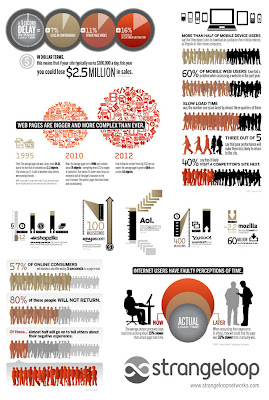
Speed is a bit of an obsession for most web users. We fret over our Internet connections’ and mobile connections’ perceived slowness, and we go bananas for a faster web browser.

4/03/2011
Top 5 Facebook Marketing Mistakes Small Businesses Make

This post originally appeared on the American Express OPEN Forum, where Mashable regularly contributes articles about leveraging social media and technology in small business.
While Facebook marketing is on the rise among small businesses, many are still struggling to master the basics.
“Many people have difficulty with just the basic Page set up,” says social media marketing consultant Nicole Krug. “For example, I still see people setting up their business as a profile page instead of a business Page. I have other clients who jumped into Groups when they came out and have divided their fan base.”
Here are five more common Facebook marketing mistakes to avoid:
1. Broadcasting
Ask any social marketing consultant what the number-one no-no is on Facebook, and he’ll likely tell you it’s “broadcasting” your messages instead of providing fans with relevant content and engaging on an continual basis.
“With Facebook, marketers of any size can do effective, word-of-mouth marketing at scale for the very first time. But Facebook is all about authenticity, so if your company is not being authentic or engaging with customers in a way that feels genuine, the community will see right through it,” says Facebook spokeswoman Annie Ta.
Peter Shankman, social media consultant, entrepreneur and author of “Customer Service: New Rules for a Social Media World,” agrees.
“Your job is to interact, not just to broadcast,” says Shankman. “Fans are looking for a reason to connect with you, and they’re showing you that by clicking ‘Like.’ Your job is to give them a reason to stay.”
According to Andy Smith, co-author of “The Dragonfly Effect: Quick, Effective and Powerful Ways to Use Social Media to Drive Social Change,” many businesses immediately ask how Facebook is going to make them money and have that be the focus, as opposed to trying to engage customers and provide a meaningful, authentic online experience. “Marketers need to recognize that people go to Facebook to make a connection or feel like part of a community,” says Smith.
2. Not Investing Adequate Time
Another common mistake is underestimating the amount of time a successful Facebook strategy entails. Many social media consultants report seeing a pervasive “set it and forget it” mentality among small businesses.
“Some small business owners are under the impression that if they set up a Page on Facebook, that’s all they have to do. They think people will just naturally come and want to be a fan of their product or service,” says Taylor Pratt of Raven Internet Marketing Tools. “But it takes much more of a commitment than that.”
It’s not just fan growth that will suffer from this approach — it may also hurt your relationships with existing fans, particularly customers who have come to expect timely responses to their posts and queries.
“Unlike traditional advertising methods such as a radio spot or a Yellow Pages listing, you can’t just create a Facebook Page and just let it run its course,” says Alex Levine, a social media strategist at Paco Communications. “Creating a Facebook Page is the first of many steps, but the Page needs to be updated and monitored constantly.”
3. Being Boring or Predictable
When they’re thinking about marketing, some business owners forget that Facebook is a social place where people share things they find funny, interesting or useful with their friends. Think about what kind of content your fans would actually want to share when planning your posts.
Shankman also cautions against becoming too predictable. “Status updates by themselves get boring. But then again, so do photos, videos and multimedia as a whole. Your job is to mix it up. The moment you become predictable, boring or annoying, they’ll hide you from their feed. So keep it varied and personal — a video here, a photo here, a tag of one of your fans here.”
Creating too much “filler” content by auto-publishing content from your blog or Twitter feed can also derail your efforts. Joseph Manna, community manager at Infusionsoft, recommends using Facebook’s native publishing tools to gain the most benefit from Facebook.
“Whatever you do, DON’T automate everything,” says Manna. “It’s nice to ‘set and forget,’ but the risk is two-fold: publishing systems sometimes have issues, and Facebook places low-priority on auto-published content.”
4. Failing to Learn About Facebook Mechanics and Tools
Since Facebook is a relatively new medium, some businesses have yet to explore all its functionality and they’re missing out on creating an optimal brand experience.
“Many small businesses do not take advantage of the tools to introduce themselves to the Facebook audience,” says Krug. “For example, the ‘Info’ tab is rarely utilized well, and very few small businesses [create] a custom welcome page.”
Krug also sees frequent mistakes around one of the most basic elements of Facebook presence: the profile image. “Most companies upload a version of their logo, but the resulting thumbnail image that shows up in news feeds often only captures a few letters in the middle of their logo — this partial, meaningless image is then how they’re branded throughout Facebook,” says Krug.
Facebook Insights, Facebook’s built-in analytics system, is also often overlooked, and with it the opportunity to analyze post-performance to see what types of content gets the most engagement.
5. Violating Facebook’s Terms
Not only is it critical to know how Facebook works and what tools are available, it’s also important to know the rules of the road — something that many businesses miss.
“Every day I see organizations endangering the communities they are growing by violating the terms they agreed to when their Facebook presence was created,” says small business marketing consultant Lisa Jenkins.
What are the most common violations? Some build a community on a personal page instead of a proper Facebook Page. Others fail to abide by Facebook’s rules around running contests. And don’t even think about “tagging” people who are in an image without their permission.
“Tagging people to get their attention is not only a violation of Terms but can be reported by those you are tagging as abusive behavior on your part — which brings your violation to Facebook’s attention and opens your Page’s content to review,” warns Jenkins.
To avoid these common mistakes, invest time in learning about the Facebook platform, educate yourself on how to build and sustain an audience, and don’t forget to engage with people like you do in real life.
“What sets small businesses apart from large companies is their ability to make personal connections with customers,” says Ben Nesvig of FuzedMarketing. “They tend to forget this when they join Facebook, yet it’s their biggest strength and asset.”
Google rinde homenaje al helado sundae

Hace 119 años el joven Chester Platt la pidió por primera vez en una heladería de la ciudad de Ithaca. Google se pone dulce. El buscador más grande e importante de Internet dejó atrás por un momento los homenajes a los grandes científicos y literatos y esta vez decidió recordar el 119 aniversario de la creación del helado sundae en EE UU.
Quizá acorde a la cada vez más cerca temporada veraniega en el hemisferio norte, Google cambió su clásico doodle para mostrar una imagen en donde un helado con doble bola provoca a millones de internautas.
El más clásico de los helados está compuesto, por lo general, por una bola de cremoso helado cubierta con jarabe de cerezas, fresa, o fudge de chocolate.
En 1992 la cadena de comida rápida McDonalds lo incluyó en su carta de postres y logró que el postre adquiriera resonancia mundial.
3/15/2011
Nuevo Adobe SocialAnalytics, de Omniture, para Supervisar, Medir y Monetizar Medios Sociales
Adobe Systems Incorporated anunció Adobe® SocialAnalytics, un nuevo producto parte de HUAdobe Online Marketing Suite, desarrollada por Omniture®, que permite a los mercadotécnicos supervisar, medir y monetizar los medios sociales. Los clientes de Adobe ahora cuentan con una sola aplicación que reúne toda la actividad relevante de las redes sociales y comunidades online e identifica cómo impacta dicha actividad las métricas clave de negocios y la percepción de marca, para finalmente guiar la actividad social en los diferentes canales e impulsar el retorno de inversión (ROI).
“Las redes sociales son el grupo foco más grande del planeta y los mercadotécnicos se esfuerzan por saber de qué forma pueden escuchar y participar mejor en ellas”, dijo Brad Rencher, vice presidente y gerente general de la Unidad de Negocios Omniture en Adobe. “Los que los mercadotécnicos han echado en falta es una solución que les ayude a identificar las voces y actividades más relevantes, ligar las actividades sociales al impacto sobre la marca y el negocio y luego tomar acciones para optimizar dicho impacto. Adobe SocialAnalytics es capaz de informar de qué manera participa una compañía en las redes sociales, evitando las aproximaciones y reemplazándolas con estrategias o experimentaciones basados en dichos resultados”.
Con Adobe SocialAnalytics, los clientes pueden supervisar y medir plataformas populares, como Facebook, YouTube, Twitter, blogs, foros y cualquier lugar en el que ocurran conversaciones sociales, para ver los datos sociales de valor en contexto con todas sus iniciativas online. Esto ayuda a los mercadotécnicos a obtener respuestas rápidas a preguntas de negocios como: ¿Cuál es el impacto de los medios sociales en mi negocio? ¿De qué manera nuestras iniciativas y conversaciones sociales están impulsando la conversión a facturación? ¿Quiénes son los influyentes sociales de mi negocio? Cuando un sentimiento social positivo llega a un punto alto, ¿sube también nuestro tráfico Web o nuestras métricas de conversión se ven impactadas positivamente?
Adobe SocialAnalytics aumenta las capacidases de optimización y medición social innovadoras existentes de las compañías, como:
Medición de Facebook
Los mercadotécnicos pueden usar Adobe SocialAnalytics para entender la efectividad de algunos de los elementos originales de Facebook como Facebook Pages, demográficas de fans, Me Gusta y Compartir, etc. Ver estos datos en contexto con las conversaciones actuales que ocurren en Facebook puede ofrecer conclusiones acerca de cómo atraer mejor a los clientes en Facebook.
Medición de Aplicación Facebook y Medición de Aplicación Móvil
Con Adobe SocialAnalytics, los mercadotécnicos pueden ver los datos de uso de sus aplicaciones en contexto con otras actividades sociales. Esto les ayuda a identificar mejor la efectividad de su estrategia de aplicaciones móviles y sociales y de qué forma dicha estrategia afecta o se ve afectada por otras actividades sociales.
Medición de Videos Virales
Usando la medición de videos virales, los clientes pueden obtener resultados acerca del desempeño de campañas de videos virales en los sitios de intercambio de videos y pueden afinar mejor la forma de usar los videos en las redes sociales.
Medición de Twitter
Esta capacidad permite a los mercadotécnicos online medir la actividad de marca en el conocido sitio de microblogging. En el contexto de Adobe SocialAnalytics, es posible ver de qué forma los picos de actividades en Twitter afectan otros canales, como las visitas a sitios y otros comportamientos online.
“Las redes sociales son el grupo foco más grande del planeta y los mercadotécnicos se esfuerzan por saber de qué forma pueden escuchar y participar mejor en ellas”, dijo Brad Rencher, vice presidente y gerente general de la Unidad de Negocios Omniture en Adobe. “Los que los mercadotécnicos han echado en falta es una solución que les ayude a identificar las voces y actividades más relevantes, ligar las actividades sociales al impacto sobre la marca y el negocio y luego tomar acciones para optimizar dicho impacto. Adobe SocialAnalytics es capaz de informar de qué manera participa una compañía en las redes sociales, evitando las aproximaciones y reemplazándolas con estrategias o experimentaciones basados en dichos resultados”.
Con Adobe SocialAnalytics, los clientes pueden supervisar y medir plataformas populares, como Facebook, YouTube, Twitter, blogs, foros y cualquier lugar en el que ocurran conversaciones sociales, para ver los datos sociales de valor en contexto con todas sus iniciativas online. Esto ayuda a los mercadotécnicos a obtener respuestas rápidas a preguntas de negocios como: ¿Cuál es el impacto de los medios sociales en mi negocio? ¿De qué manera nuestras iniciativas y conversaciones sociales están impulsando la conversión a facturación? ¿Quiénes son los influyentes sociales de mi negocio? Cuando un sentimiento social positivo llega a un punto alto, ¿sube también nuestro tráfico Web o nuestras métricas de conversión se ven impactadas positivamente?
Adobe SocialAnalytics aumenta las capacidases de optimización y medición social innovadoras existentes de las compañías, como:
Medición de Facebook
Los mercadotécnicos pueden usar Adobe SocialAnalytics para entender la efectividad de algunos de los elementos originales de Facebook como Facebook Pages, demográficas de fans, Me Gusta y Compartir, etc. Ver estos datos en contexto con las conversaciones actuales que ocurren en Facebook puede ofrecer conclusiones acerca de cómo atraer mejor a los clientes en Facebook.
Medición de Aplicación Facebook y Medición de Aplicación Móvil
Con Adobe SocialAnalytics, los mercadotécnicos pueden ver los datos de uso de sus aplicaciones en contexto con otras actividades sociales. Esto les ayuda a identificar mejor la efectividad de su estrategia de aplicaciones móviles y sociales y de qué forma dicha estrategia afecta o se ve afectada por otras actividades sociales.
Medición de Videos Virales
Usando la medición de videos virales, los clientes pueden obtener resultados acerca del desempeño de campañas de videos virales en los sitios de intercambio de videos y pueden afinar mejor la forma de usar los videos en las redes sociales.
Medición de Twitter
Esta capacidad permite a los mercadotécnicos online medir la actividad de marca en el conocido sitio de microblogging. En el contexto de Adobe SocialAnalytics, es posible ver de qué forma los picos de actividades en Twitter afectan otros canales, como las visitas a sitios y otros comportamientos online.
2/14/2011


2/04/2011
Ten principles that contribute to a Google user experience

1. Focus on people their lives, their work, their dreams.
The Google User Experience team works to discover people‘s actual needs, including needs they can‘t always articulate. Armed with that information, Google can create products that solve real-world problems and spark the creativity of all kinds of people. Improving people‘s lives, not just easing step-by-step tasks, is our goal.
Above all, a well-designed Google product is useful in daily life. It doesn‘t try to impress users with its whizbang technology or visual style – though it might have both. It doesn‘t strong-arm people to use features they don‘t want – but it does provide a natural growth path for those who are interested. It doesn‘t intrude on people‘s lives – but it does open doors for users who want to explore the world‘s information, work more quickly and creatively, and share ideas with their friends or the world.
2. Every millisecond counts.
Nothing is more valuable than people‘s time. Google pages load quickly, thanks to slim code and carefully selected image files. The most essential features and text are placed in the easiest-to-find locations. Unnecessary clicks, typing, steps, and other actions are eliminated. Google products ask for information only once and include smart defaults. Tasks are streamlined.
Speed is a boon to users. It is also a competitive advantage that Google doesn‘t sacrifice without good reason.
3. Simplicity is powerful.
Simplicity fuels many elements of good design, including ease of use, speed, visual appeal, and accessibility. But simplicity starts with the design of a product‘s fundamental functions. Google doesn‘t set out to create feature-rich products; our best designs include only the features that people need to accomplish their goals. Ideally, even products that require large feature sets and complex visual designs appear to be simple as well as powerful.
Google teams think twice before sacrificing simplicity in pursuit of a less important feature. Our hope is to evolve products in new directions instead of just adding more features.
4. Engage beginners and attract experts.
Designing for many people doesn‘t mean designing for the lowest common denominator. The best Google designs appear quite simple on the surface but include powerful features that are easily accessible to those users who want them. Our intent is to invite beginners with a great initial experience while also attracting power users whose excitement and expertise will draw others to the product.
A well-designed Google product lets new users jump in, offers help when necessary, and ensures that users can make simple and intuitive use of the product‘s most valuable features. Progressive disclosure of advanced features encourages people to expand their usage of the product. Whenever appropriate, Google offers smart features that entice people with complex online lives – for instance, people who share data across several devices and computers, work online and off, and crave storage space.
5. Dare to innovate.
Design consistency builds a trusted foundation for Google products, makes users comfortable, and speeds their work. But it is the element of imagination that transforms designs from ho-hum to delightful.
Google encourages innovative, risk-taking designs whenever they serve the needs of users. Our teams encourage new ideas to come out and play. Instead of just matching the features of existing products, Google wants to change the game.
6. Design for the world.
The World Wide Web has opened all the resources of the Internet to people everywhere. For example, many users are exploring Google products while strolling with a mobile device, not sitting at a desk with a personal computer. Our goal is to design products that are contextually relevant and available through the medium and methods that make sense to users. Google supports slower connections and older browsers when possible, and Google allows people to choose how they view information (screen size, font size) and how they enter information (smart query parsing). The User Experience team researches the fundamental differences in user experiences throughout the world and works to design the right products for each audience, device, and culture. Simple translation, or “graceful degradation” of a feature set, isn‘t sufficient to meet people‘s needs.
Google is also committed to improving the accessibility of its products. Our desire for simple and inclusive products, and Google‘s mission to make the world‘s information universally accessible, demand products that support assistive technologies and provide a useful and enjoyable experience for everyone, including those with physical and cognitive limitations.
7. Plan for today‘s and tomorrow‘s business.
Those Google products that make money strive to do so in a way that is helpful to users. To reach that lofty goal, designers work with product teams to ensure that business considerations integrate seamlessly with the goals of users. Teams work to make sure ads are relevant, useful, and clearly identifiable as ads. Google also takes care to protect the interests of advertisers and others who depend on Google for their livelihood.
Google never tries to increase revenue from a product if it would mean reducing the number of Google users in the future. If a profitable design doesn‘t please users, it‘s time to go back to the drawing board. Not every product has to make money, and none should be bad for business.
8. Delight the eye without distracting the mind.
If people looked at a Google product and said ”Wow, that‘s beautiful!” the User Experience team would cheer. A positive first impression makes users comfortable, assures them that the product is reliable and professional, and encourages people to make the product their own.
A minimalist aesthetic makes sense for most Google products because a clean, clutter-free design loads quickly and doesn‘t distract users from their goals. Visually appealing images, color, and fonts are balanced against the needs for speed, scannable text, and easy navigation. Still, ”simple elegance” is not the best fit for every product. Audience and cultural context matter. A Google product‘s visual design should please its users and improve usability for them.
9. Be worthy of people‘s trust.
Good design can go a long way to earn the trust of the people who use Google products. Establishing Google‘s reliability starts with the basics – for example, making sure the interface is efficient and professional, actions are easily reversed, ads are clearly identified, terminology is consistent, and users are never unhappily surprised. In addition, Google products open themselves to the world by including links to competitors and encouraging user contributions such as community maps or iGoogle gadgets.
A greater challenge is to make sure that Google demonstrates respect for users‘ right to control their own data. Google is transparent about how it uses information and how that information is shared with others (if at all), so that users can make informed choices. Our products warn users about such dangers as insecure connections, actions that may make users vulnerable to spam, or the possibility that data shared outside Google may be stored elsewhere. The larger Google becomes, the more essential it is to live up to our “Don‘t be evil” motto.
10. Add a human touch.
Google includes a wide range of personalities, and our designs have personality, too. Text and design elements are friendly, quirky, and smart – and not boring, close-minded, or arrogant. Google text talks directly to people and offers the same practical, informal assistance that anyone would offer to a neighbor who asked a question. And Google doesn‘t let fun or personality interfere with other elements of a design, especially when people‘s livelihood, or their ability to find vital information, is at stake.
Google doesn‘t know everything, and no design is perfect. Our products ask for feedback, and Google acts on that feedback. When practicing these design principles, the Google User Experience team seeks the best possible balance in the time available for each product. Then the cycle of iteration, innovation, and improvement continues.
Subscribe to:
Posts (Atom)