


9/22/2011
The Three Types of Companies: Biggest, Better, and Different
I want to share with you, I’ve found there are only three types of companies. Once you understand the three variations, you’ll be a better consumer, marketer, or leader.
I take a lot of briefings from companies, in fact, hundreds every year. I also meet with many different corporations who are our clients for longer term engagements and have found a clear pattern in just about every industry. In fact this doesn’t just apply to the brand, but also the specific products within a market. And deep down, when you look carefully, you’ll find this applies to siblings too.
The Three Types of Companies:
1) Biggest.
This company or product, will always make the claim they are the biggest, largest, have the most customers. You’ve heard of how McDonalds’ has served billions of Hamburgers, or how Microsoft has sold the most software licenses, or how Ford was the first auto manufacture, or Coke is the top beverage brand on the planet.. You’ll also know these companies as they’ll tout their rankings on Fortune 100, or financial growth. Often, these companies are the standard, and all others measure up to them, “We are the largest, the first, the wealthiest”. We often find these products fit the masses, but may lack in other areas such as specialization or variety.2) Better.
This company or product, is locked in a second place position against Biggest. For example, you’ve heard of how Burger King offers variety of their menu, or how Dell offered the customized on the web products over 10 years ago, or how Toyota challenge big cards during the gas crises decades ago, or how Pepsi wants you to take their taste challenge. They will differentiate by making their products better than the competitors, by changing variety, pricing, or customization, “We’re better than the other guys, who can’t serve everyone’s needs”. We often find these companies to offer premium alternatives, suiting for more than mainstream appetite.3) Different.
This company or product will distinctly position themselves as an alternative to the the first two by offering a complete different option. Perhaps you’ve tried In-N-Out Burger, or seen how Apple wants you to think different with their products, or how Mini wants you to drive their unique cars, or how 7up positioned themselves as the UnCola. They will attack the primary model of the first two, and suggest they are only for a certain type of buyer. “be different, stand out, and we’re only for distinguished tastes”. These companies have specific offerings, that buck the trend, and will go out of their way to stand apart.
A few rules of the road: It goes without saving that multiple companies and products can all fit in one category, we often see multiple companies claiming to be the top dog. And also we should expect to see companies traverse these three different categories, and all of that is normal.
Now that you know the three types of companies, you can start to be a better buyer, marketer, and leader. Know where they fit in the your selection process, and know where you fit between Biggest, Better, and Different. Source: Jeremiah Owyang / SF, Silicon Valley
SEO vs PPC
If you want to attract visitors to your site then there are a couple of ways of doing this. Among the most popular and effective ones are SEO and PPC. Which one is better?
I have been thinking about this issue for a while and have come up with a few points to try and help me reach a final decision. Let’s take a look.
The Cost
PPC stands for Pay Per Click. As the name suggests, you pay for every time someone clicks on your ad and gets directed to your site. In theory this means that the more visitors you receive the more you pay. Anyone who is completely confident of converting the majority of their visitors into paying customers should get big benefits out of this. SEO is all about search engine optimization and the price you pay is generally not related to the results you get. You will be paying for a package which involves carrying out the tasks necessary to get you up the search engine rankings. However, you are not paying for the results as such but rather for the process.
The Results
In SEO the results you see will really depend upon how competitive a market you are operating in. For instance, if you are up against some big hitting sites then you are going to have to plug away for a while before getting into a good position on the rankings. On the other hand, if the competition is pretty puny then you should sweep them aside more easily. PPC is a different kettle of fish, as you aren’t really battling it out to get more visibility; you are paying for it. You would think that this means that the results are more guaranteed but I have a spanner to throw in the works. With SEO the people who find you are those who are looking for you. With PPC you might get a lot of idle clickers reaching your site. If your page is SEO optimized for your keywords and it has been done professionally then you know exactly what your visitors have typed in as their searches. With PPC you are attracting visitors who were maybe looking at something completely different but saw your advert and decided to have a look at it. Therefore, they probably have less intention of buying something when they enter your site.
The Long Term Sustainability
The final point I want to consider is which of these two methods is better in the long run. This is another close call and again comes down to the website’s own position in the overall market. For example, if I have a site which doesn’t have particularly strong competition then I can run some SEO work for a few months and blitz my way to the top of the rankings. If the rival sites don’t wake up then I can carry on in my lofty position with little or no maintenance work or costs. With the PPC approach you only get what you pay for. If you stop doing it you stop getting visitors from it, as simple as that.
Takeaway
This means that I have to go with SEO here, as it is something which is designed specifically to give your site visibility on an ongoing basis. Getting business from organic searches seems to me like the most natural and long term solution to finding your next generation of customers.
9/11/2011
5 Great Content Strategy Resources
Content strategy is a topic that I find myself talking about with people more and more lately through my job as Manager of Communications, Web Content and Community at Connecting Up. Through these conversations, I get asked questions like: “So, what is it?”, “What should be part of a content strategy?”, and “How do we get one for our organisation?”
So, I keep saying that I’d blog about everything I know about content strategy (Mind you, I don’t know everything about it! I’m still learning a lot. And mostly, learning on the job.). But, like many things on my “To Blog” list, it keeps getting pushed down the list.
But, today, during one of my regular content meetings*, I was reminded that I haven’t really shared much of what I know about something that I’ve been doing for years. You see, my basic training on content strategy has officially started in 2000, when I joined About.com as a Guide for Language Arts for Kids. And again, when I rejoined them in 2004 as the first Guide to Web Logs. In-between 2000 and now, I’ve planned and created dozens of sites, including a whole network of blogs.
So, after over a decade of working on content strategy, and having the word ‘content’ in my official job title nowadays, I figured it may be time to start sharing. And, I’d like to start off my content strategy sharing by pointing you to five of my favourite resources (there’s more, but let’s stick to 5 for now):
1. The Elements of Content Strategy by Erin Kissane – I really liked the simplicity and brevity of this book. It’s a great little “starter” book for anyone thinking of understanding content strategy better. It doesn’t have a lot of how tos/templates on getting a content strategy up and running, but it’s a good way to get an overview of the topic without feeling overwhelmed.
2. Content Strategy for the Web by Kristina Halvorson – This book is both an overview and an in-depth look on content strategy. It has some really great insights on why there is a need to have one, and what may be the necessary steps to create one. It’s more comprehensive than “Elements…” so it may be overwhelming for people who are still trying to get their heads around content strategy. But, if information overload doesn’t put you off, then this book is definitely a good resource to work with.
3. The Web Content Strategist’s Bible: The Complete Guide To A New And Lucrative Career For Writers Of All Kinds by Richard Sheffield – Another great, comprehensive resource on content strategy. Some useful insights on different aspects of content development, such as design, matrix, and even translation.
4. Chief Content Officer – This is a print and/or digital for content specialists. While it’s not primarily on content strategy, the articles in this quarterly publication are very useful for anyone interested in the topic. There’s an Australian version and a U.S. version, I believe. The one linked here is the Australian version. Oh, and as a bonus, I just found out that Contents Magazine is also coming out soon, which is a publication on content strategy and related topics.
5. Content Strategy Group on LinkedIn – Moving on from reading material, I thought I’d also share a network/community resource. On this front, I highly recommend the Content Strategy Group on LinkedIn. There isn’t a lot of activity, but I always find something useful in the discussions and resource sharing within the group. So, it’s definitely an online community of content strategists that’s worth connecting with.
Social Media and Real Estate

Information overload is what most people feel when researching real estate. It's overwhelming the amount of data available on the internet. Some of it is junk, some of it is advertising, and a lot of it is just wrong. People are starved to get quality reliable information they can trust. So consumers gravitate to sites and communities that shared their interests and points of views. Sites like Yelp, Facebook, Branch Out, Twitter exploded because they satisfied this need. Knowing what their peers think and find interesting helps shape a consumer's opinion. People are not looking for just info anymore, they are looking for recommendations. It's the power of feedback. The testament of a testimonial. It helps them edit down their choices.
Real estate used to be a private transaction between a Realtor and client. However, it is increasingly now a shared social experience for a community. Open house visitors upload photos of what they saw, buyers blog about their inspection, sellers search Twitter streams for mentions of their house, agents get rated online. Today's buyers and sellers rely heavily on social media. Yet this is lost on many of my colleagues who cling to an era when agents were the gatekeepers of info. Tsk tsk.
So, next time you interview a real estate agent, ask them:
1. What are your strategies for marketing my property?
If they just mention fliers, open houses and website, tell them this ain’t the 1990’s! If they cite social media as part of their plan, ensure they really possess the social media savoir faire to meet your needs. (ie, Posting once a month on their facebook business page doesn't cut it. They obviously have a facebook page for the sake of having a facebook page, which is useless to you as a client).
2. How big is your social following?
If an agent has 10,000 twitter followers who hang on to their every word about real estate, that is 20,000 eyeballs on your listing. That’s more exposure than any flyer or open house will get you. One tweet to plug your home and it is on the radar of thousands of people.
3. Who follows you and how engaged are they?
Perhaps your agent's online tribe isn't the largest, but it may be an active targeted demographic. It’s a good sign when local businesses, past clients and even other real estate professionals are fans of a Realtor. (You can tell a lot about how engaged an agent is by reading their online chatter with other followers.) These people who have “liked” the agent’s page actively chose to read what that agent posts. They clearly expressed an interest in your agents business and want to keep tabs on their local market. With any luck, they will share/viralize your property to their sphere as well!
Bottom line: The traditionally stodgy real estate industry is finally catching on that social media can't be ignored. An agent with strong social media savvy can command a lot of attention towards your house for sale. The more people who are aware of your listing, the more likely someone will write an offer. In this market, a seller can not afford to lose out on any marketing edge, especially when Gen X/Y and Millenials are driving the market now. And guess what, they live on social media. Select your agent representation accordingly.
Editor's note: the following is a guest post by Herman Chan.
8/30/2011
The End of Social Media 1.0
I would like to talk about an inflection point in social media that requires pause. I am not suggesting that there will be a social media 2.0 or 3.0 for that matter. Nor do I see the term social media departing our vocabulary any time soon. After all, it was recently added to the Merriam-Webster dictionary. Instead, what I would like to discuss is the end of an era of social media that will force the industry to mature. It won’t happen on its own however. Evolution will occur because consumers demand it and also because you’re willing to stake your job on it.
From Social Network Fatigue to Deals Fatigue to Follow Fatigue, businesses are facing a crossroads at the intersection of social and media. Following the path of media continues a long tradition of what Tom Foremski refers to as “Social Media as Corporate Media.” Following the path of social is a journey towards relevance.
As Foremski states, “Social media is not corporate media…if corporations try to turn social media into a corporate sales or marketing channel then they risk losing the naked conversations, and the insight into customer behaviors.”
His point is that there’s more to social media than clever campaigns and rudimentary conversations. Talking isn’t the only thing that makes social media social. Just like adding Facebook, Twitter and other sharing buttons will not magically transform static content into shareable experiences. Listening, learning and adapting is where the real value of social media will show its true colors. Listening leads to a more informed business. Engagement unlocks empathy and innovation. But it is action and adaptation that leads to relevance. And, it never ends.
Indeed, there really are more examples of media than there are that of social media in many of the celebrated examples out there today. Even though distributing corporate media in social channels sets the stage for dialogue, there really isn’t much that’s social about it. In fact, study of many social media initiatives have led me to believe that much of what we benchmark against is actually anti-social in its approach.
The future of social media comes down to one word, “value.” Without it, businesses will find it much more difficult to earn and retain friends, fans and followers (3F’s). As adoption of social networks soared in previous years, growth is now plateauing. eMarketer estimates that Facebook growth will hit only 13.4% this year after experiencing 38.6% acceleration in 2010 and a staggering 90.3% ascension the year before. Facebook isn’t alone in its sobriety either. The rate of Twitter user adoption fell from 293.1% growth in 2009 to 26.3% this year.
Don’t get me wrong, people are still embracing social networks. However, the severity of competition for consumer attention is now unmistakable. Once liberal with their likes, Retweets, and follows, consumers are becoming much more guarded and realistic. Therefore brands will now have to more effectively listen to markets to make more informed decisions about how social media impacts the enterprise and in turn customer experiences.
The GlobalWebIndex “Wave 5 Trends” report delivers insight into how consumers are using social networks and technology in general. According to the report, growth in social network usage among 16- to 24-year-olds in the US is stalling. And, in a few countries usage within this group is declining. In fact, one of the key insights shared in the report is subduing, “Facebook is no longer the one stop shop for the total internet experience.”
However, the report is not a harbinger of social networking’s demise. It is merely a lens into how behavior is changing. This is important for any business to realize that business as usual in social networks is in fact anything but.
Between June 2009 and June 2011, the following changes were noted in Facebook activity:
- Uploading videos is experiencing a modest increase around the world up 5% in the U.S. and 7.6% worldwide.
- Installing apps is on the decline, down 10.4% in the U.S. and 3.1% worldwide.
- Sending virtual gifts may not be gifts worth giving after all, with numbers declining 12.9% in the U.S. and 7.5% around the world.
Twitter on the other hand is a rich exchange for information commerce, where links become a form of digital currency. For example, 45% share an opinion about a product or brand more than once per day. Another 34% of Twitter users also share a link about a product or brand more than once per day.
When asked what consumers want from brands, knowledge and entertainment soared to the top of the list. Additionally, The GlobalWebIndex Wave 5 Trends report tells us that online consumers want brands to provide services that fit with their lifestyle. They also want brands to listen to them.
What can we learn of this?
1) Businesses must first realize that there’s more to social media than just managing an active presence, driven by an active editorial calendar. Listening is key and within each conversation lies a clue to earn relevance and ultimately establish leadership.
2) Consumers want to be heard. Social media will have to break free form the grips of marketing in order to truly socialize the enterprise to listen, engage, learn, and adapt. You can’t create a social business if the business is not designed to be customer-centric from the outside-in and the inside-out.
3) Social media becomes an extension of active listening and engagement. Strategies, programs, and content are derivative of insights, catalysts for innovation, and messengers of value. More importantly, social media becomes a platform for the brand and the functions that consumers deem mandatory. From marketing to HR to service to R&D, brands will expand the role they play in social networking to make the acts of following and sharing an investment in a more meaningful relationship.
The end of Social Media 1.0 is the beginning of a new era of business, consumer engagement, and relevance.
From Social Network Fatigue to Deals Fatigue to Follow Fatigue, businesses are facing a crossroads at the intersection of social and media. Following the path of media continues a long tradition of what Tom Foremski refers to as “Social Media as Corporate Media.” Following the path of social is a journey towards relevance.
As Foremski states, “Social media is not corporate media…if corporations try to turn social media into a corporate sales or marketing channel then they risk losing the naked conversations, and the insight into customer behaviors.”
His point is that there’s more to social media than clever campaigns and rudimentary conversations. Talking isn’t the only thing that makes social media social. Just like adding Facebook, Twitter and other sharing buttons will not magically transform static content into shareable experiences. Listening, learning and adapting is where the real value of social media will show its true colors. Listening leads to a more informed business. Engagement unlocks empathy and innovation. But it is action and adaptation that leads to relevance. And, it never ends.
Indeed, there really are more examples of media than there are that of social media in many of the celebrated examples out there today. Even though distributing corporate media in social channels sets the stage for dialogue, there really isn’t much that’s social about it. In fact, study of many social media initiatives have led me to believe that much of what we benchmark against is actually anti-social in its approach.
The future of social media comes down to one word, “value.” Without it, businesses will find it much more difficult to earn and retain friends, fans and followers (3F’s). As adoption of social networks soared in previous years, growth is now plateauing. eMarketer estimates that Facebook growth will hit only 13.4% this year after experiencing 38.6% acceleration in 2010 and a staggering 90.3% ascension the year before. Facebook isn’t alone in its sobriety either. The rate of Twitter user adoption fell from 293.1% growth in 2009 to 26.3% this year.
Don’t get me wrong, people are still embracing social networks. However, the severity of competition for consumer attention is now unmistakable. Once liberal with their likes, Retweets, and follows, consumers are becoming much more guarded and realistic. Therefore brands will now have to more effectively listen to markets to make more informed decisions about how social media impacts the enterprise and in turn customer experiences.
The GlobalWebIndex “Wave 5 Trends” report delivers insight into how consumers are using social networks and technology in general. According to the report, growth in social network usage among 16- to 24-year-olds in the US is stalling. And, in a few countries usage within this group is declining. In fact, one of the key insights shared in the report is subduing, “Facebook is no longer the one stop shop for the total internet experience.”
However, the report is not a harbinger of social networking’s demise. It is merely a lens into how behavior is changing. This is important for any business to realize that business as usual in social networks is in fact anything but.
Between June 2009 and June 2011, the following changes were noted in Facebook activity:
- Uploading videos is experiencing a modest increase around the world up 5% in the U.S. and 7.6% worldwide.
- Installing apps is on the decline, down 10.4% in the U.S. and 3.1% worldwide.
- Sending virtual gifts may not be gifts worth giving after all, with numbers declining 12.9% in the U.S. and 7.5% around the world.
Twitter on the other hand is a rich exchange for information commerce, where links become a form of digital currency. For example, 45% share an opinion about a product or brand more than once per day. Another 34% of Twitter users also share a link about a product or brand more than once per day.
When asked what consumers want from brands, knowledge and entertainment soared to the top of the list. Additionally, The GlobalWebIndex Wave 5 Trends report tells us that online consumers want brands to provide services that fit with their lifestyle. They also want brands to listen to them.
What can we learn of this?
1) Businesses must first realize that there’s more to social media than just managing an active presence, driven by an active editorial calendar. Listening is key and within each conversation lies a clue to earn relevance and ultimately establish leadership.
2) Consumers want to be heard. Social media will have to break free form the grips of marketing in order to truly socialize the enterprise to listen, engage, learn, and adapt. You can’t create a social business if the business is not designed to be customer-centric from the outside-in and the inside-out.
3) Social media becomes an extension of active listening and engagement. Strategies, programs, and content are derivative of insights, catalysts for innovation, and messengers of value. More importantly, social media becomes a platform for the brand and the functions that consumers deem mandatory. From marketing to HR to service to R&D, brands will expand the role they play in social networking to make the acts of following and sharing an investment in a more meaningful relationship.
The end of Social Media 1.0 is the beginning of a new era of business, consumer engagement, and relevance.
6/21/2011
ICANN Approves Historic Change to Internet's Domain Name System Board Votes to Launch New Generic Top-Level Domains
ICANN's Board of Directors has approved a plan to usher in one of the biggest changes ever to the Internet's Domain Name System. The Board vote was 13 approving, 1 opposed, and 2 abstaining.
During a special meeting, the Board approved a plan to dramatically increase the number of Internet domain name endings -- called generic top-level domains (gTLDs) -- from the current 22, which includes such familiar domains as .com, .org and .net.
"ICANN has opened the Internet's naming system to unleash the global human imagination. Today's decision respects the rights of groups to create new Top Level Domains in any language or script. We hope this allows the domain name system to better serve all of mankind," said Rod Beckstrom, President and Chief Executive Officer of ICANN.
New gTLDs will change the way people find information on the Internet and how businesses plan and structure their online presence. Internet address names will be able to end with almost any word in any language, offering organizations around the world the opportunity to market their brand, products, community or cause in new and innovative ways.
"Today's decision will usher in a new Internet age," said Peter Dengate Thrush, Chairman of ICANN's Board of Directors. "We have provided a platform for the next generation of creativity and inspiration."
The decision to proceed with the gTLD program follows many years of discussion, debate and deliberation with the Internet community, business groups and governments. The Applicant Guidebook, a rulebook explaining how to apply for a new gTLD, went through seven significant revisions to incorporate more than 1,000 comments from the public. Strong efforts were made to address the concerns of all interested parties, and to ensure that the security, stability and resiliency of the Internet are not compromised.
ICANN will soon begin a global campaign to tell the world about this dramatic change in Internet names and to raise awareness of the opportunities afforded by new gTLDs. Applications for new gTLDs will be accepted from 12 January 2012 to 12 April 2012.
Journalist and media expert Oksana Prykhodko arrived at ICANN 40 in San Francisco with a mission. She had set out to improve understanding in Ukraine of the importance of the Internet.
Oksana characterizes the week that followed as "great, wonderful, and a little crazy." She found an ally in the manager of the Russian country code top level domain, and gained insight into Internationalized Domain Names (IDNs). Attending her first ICANN meeting as a Fellow, Oksana found the experience rewarding – and three short months later, has been elected Secretariat of the European Regional At-Large Organization (EURALO). She also has joined the Working Group for Cyrillic IDNs.
Can participating in ICANN's volunteer community accelerate your Internet agenda? Quite possibly. Listen to Oksana's video. Then, if you're from a developing country, consider applying to ICANN's Fellowship Program to attend a future ICANN meeting with some travel expenses covered.
The application round for attending our October meeting in Dakar, Senegal, as a Fellow is open until 8 July 2011.
Friendly, outgoing, and technologically savvy, Fouad Bajwa was the State Webmaster for the government of Pakistan. When he returned to private sector employment, he thirsted for technical knowledge that could keep him relevant in the international market as he promoted the open-source movement.
Despite strong doubts regarding ICANN's model and motives, Fouad attended our meeting in Seoul, South Korea, in 2009. Today, he volunteers as the co-Vice Chair for the Asian-Pacific Regional At-Large Organization (APRALO), a key part of ICANN's At-Large community.
What changed Fouad's opinion of ICANN? And how has working with ICANN helped this accomplished IT trainer? Hear Fouad's story, in his own words, in the accompanying video.
This video continues the "Who Is ICANN?" series we launched last week. Part One introduced Mistura Aruna of Nigeria.
Fouad attended his first ICANN meeting courtesy of the Fellowship Program. If you're from a developing country, you can learn more about the Program on our ICANN Meeting Fellowships page. Apply now to attend our October meeting in Dakar, Senegal, as a Fellow. The deadline for applying is 8 July 2011.
During a special meeting, the Board approved a plan to dramatically increase the number of Internet domain name endings -- called generic top-level domains (gTLDs) -- from the current 22, which includes such familiar domains as .com, .org and .net.
"ICANN has opened the Internet's naming system to unleash the global human imagination. Today's decision respects the rights of groups to create new Top Level Domains in any language or script. We hope this allows the domain name system to better serve all of mankind," said Rod Beckstrom, President and Chief Executive Officer of ICANN.
New gTLDs will change the way people find information on the Internet and how businesses plan and structure their online presence. Internet address names will be able to end with almost any word in any language, offering organizations around the world the opportunity to market their brand, products, community or cause in new and innovative ways.
"Today's decision will usher in a new Internet age," said Peter Dengate Thrush, Chairman of ICANN's Board of Directors. "We have provided a platform for the next generation of creativity and inspiration."
The decision to proceed with the gTLD program follows many years of discussion, debate and deliberation with the Internet community, business groups and governments. The Applicant Guidebook, a rulebook explaining how to apply for a new gTLD, went through seven significant revisions to incorporate more than 1,000 comments from the public. Strong efforts were made to address the concerns of all interested parties, and to ensure that the security, stability and resiliency of the Internet are not compromised.
ICANN will soon begin a global campaign to tell the world about this dramatic change in Internet names and to raise awareness of the opportunities afforded by new gTLDs. Applications for new gTLDs will be accepted from 12 January 2012 to 12 April 2012.
Journalist and media expert Oksana Prykhodko arrived at ICANN 40 in San Francisco with a mission. She had set out to improve understanding in Ukraine of the importance of the Internet.
Oksana characterizes the week that followed as "great, wonderful, and a little crazy." She found an ally in the manager of the Russian country code top level domain, and gained insight into Internationalized Domain Names (IDNs). Attending her first ICANN meeting as a Fellow, Oksana found the experience rewarding – and three short months later, has been elected Secretariat of the European Regional At-Large Organization (EURALO). She also has joined the Working Group for Cyrillic IDNs.
Can participating in ICANN's volunteer community accelerate your Internet agenda? Quite possibly. Listen to Oksana's video. Then, if you're from a developing country, consider applying to ICANN's Fellowship Program to attend a future ICANN meeting with some travel expenses covered.
The application round for attending our October meeting in Dakar, Senegal, as a Fellow is open until 8 July 2011.
Friendly, outgoing, and technologically savvy, Fouad Bajwa was the State Webmaster for the government of Pakistan. When he returned to private sector employment, he thirsted for technical knowledge that could keep him relevant in the international market as he promoted the open-source movement.
Despite strong doubts regarding ICANN's model and motives, Fouad attended our meeting in Seoul, South Korea, in 2009. Today, he volunteers as the co-Vice Chair for the Asian-Pacific Regional At-Large Organization (APRALO), a key part of ICANN's At-Large community.
What changed Fouad's opinion of ICANN? And how has working with ICANN helped this accomplished IT trainer? Hear Fouad's story, in his own words, in the accompanying video.
This video continues the "Who Is ICANN?" series we launched last week. Part One introduced Mistura Aruna of Nigeria.
Fouad attended his first ICANN meeting courtesy of the Fellowship Program. If you're from a developing country, you can learn more about the Program on our ICANN Meeting Fellowships page. Apply now to attend our October meeting in Dakar, Senegal, as a Fellow. The deadline for applying is 8 July 2011.
5/10/2011
Adobe Anuncia Disponibilidad de Aplicaciones Photoshop Touch para iPad
Adobe Systems Incorporated (Nasdaq:ADBE) anunció la disponibilidad inmediata de las aplicaciones de Adobe® Photoshop® Touch (Adobe Color Lava, Adobe Eazel y Adobe Nav) para Apple iPad en Apple App Store. Estas tres aplicaciones de Adobe fueron desarrolladas usando el Kit de Desarrollo de Software (SDK) Photoshop Touch para demostrar el potencial de la interacción entre Photoshop y los dispositivos tipo tableta.
Adobe Color Lava para Photoshop, Adobe Eazel para Photoshop y Adobe Nav para Photoshop reúnen la experiencia divertida e interactiva de los dispositivos de pantalla táctil con el poder y precisión de Photoshop permitiendo a los usuarios crear muestras de color personalizadas, pintar directamente en la pantalla y usar conocidas herramientas de Photoshop desde sus dispositivos tipo tableta.‡ Estas aplicaciones aprovechan la pantalla táctil del iPad para ofrecer una experiencia móvil táctil y rica para todos los sentidos y amplían los avances realizados por Adobe en el mercado de móviles y tabletas, que empezó con Photoshop Express, Adobe Ideas y Adobe Connect™ Mobile.
Photoshop es parte de la familia de producto Adobe® Creative Suite® 5.5 recientemente anunciada, con la que diseñadores y desarrolladores en todo el mundo pueden crear contenido para las más recientes plataformas de teléfonos inteligentes y tabletas. Los usuarios actuales de Photoshop CS5 pueden descargar la actualización de forma gratuita y empezar a disfrutar de la interacción entre Photoshop y los dispositivos tipo tableta.
Los primeros comentarios de la industria acerca de las aplicaciones Photoshop Touch han sido muy positivos; en una revisión First Look de Macworld, Lesa Snider dice que “al no tener obstáculos entre tu pieza de arte y tú, puedes enfocarte en crear en el más puro sentido”. Snider también denota emoción acerca del nuevo SDK de Photoshop Touch, diciendo “no tengo duda de que los desarrolladores no querrán soltarlo hasta dominar la tecnología y crear otras útiles aplicaciones Photoshop integradas”.
El SDK de Photoshop Touch hace que sea posible desarrollar para numerosos dispositivos, como iOS®, Android® y BlackBerry® Playbook®. Con el SDK, los desarrolladores tendrán amplio acceso a la funcionalidad de Photoshop con la libertad para innovar y crear nuevas aplicaciones o agregar capacidades a las existentes. Adobe ya está comprometido con un número de desarrolladores para incorporar las tabletas y otros dispositivos a los flujos de trabajo creativos, lo que dará a los usuarios de Photoshop mayor poder de vanguardia.
Photoshop Touch y los Procesos Creativos
Adobe Color Lava permite que los creativos usen la punta de sus dedos para mezclar colores en el iPad y crear muestras personalizadas de color que puedan luego transferir a Photoshop.
Adobe Eazel aprovecha la avanzada tecnología de pintura para que los artistas creen pinturas realísticas enriquecidas con la punta de sus dedos, y presenta un nuevo tipo de interacción entre pinturas “húmedas” y “secas”. Estas pinturas pueden luego enviarse directamente a Photoshop CS5 para composición o para trabajar más en la pieza de arte.
Adobe Nav incrementa la eficiencia del flujo de trabajo porque permite que los usuarios seleccionen y controlen las herramientas de Photoshop usando el iPad como la superficie de entrada, personalicen la barra de herramientas, exploren y hagan acercamientos en hasta 200 archivos abiertos de Photoshop, o creen fácilmente nuevos archivos.
Kit de Desarrollo de Software Adobe PhotoShop Touch (SDK) para que los desarrolladores elaboren aplicaciones de tableta que interactúen con Photoshop desde dispositivos Android, BlackBerry PlayBook y iOS.
Adobe Color Lava para Photoshop, Adobe Eazel para Photoshop y Adobe Nav para Photoshop reúnen la experiencia divertida e interactiva de los dispositivos de pantalla táctil con el poder y precisión de Photoshop permitiendo a los usuarios crear muestras de color personalizadas, pintar directamente en la pantalla y usar conocidas herramientas de Photoshop desde sus dispositivos tipo tableta.‡ Estas aplicaciones aprovechan la pantalla táctil del iPad para ofrecer una experiencia móvil táctil y rica para todos los sentidos y amplían los avances realizados por Adobe en el mercado de móviles y tabletas, que empezó con Photoshop Express, Adobe Ideas y Adobe Connect™ Mobile.
Photoshop es parte de la familia de producto Adobe® Creative Suite® 5.5 recientemente anunciada, con la que diseñadores y desarrolladores en todo el mundo pueden crear contenido para las más recientes plataformas de teléfonos inteligentes y tabletas. Los usuarios actuales de Photoshop CS5 pueden descargar la actualización de forma gratuita y empezar a disfrutar de la interacción entre Photoshop y los dispositivos tipo tableta.
Los primeros comentarios de la industria acerca de las aplicaciones Photoshop Touch han sido muy positivos; en una revisión First Look de Macworld, Lesa Snider dice que “al no tener obstáculos entre tu pieza de arte y tú, puedes enfocarte en crear en el más puro sentido”. Snider también denota emoción acerca del nuevo SDK de Photoshop Touch, diciendo “no tengo duda de que los desarrolladores no querrán soltarlo hasta dominar la tecnología y crear otras útiles aplicaciones Photoshop integradas”.
El SDK de Photoshop Touch hace que sea posible desarrollar para numerosos dispositivos, como iOS®, Android® y BlackBerry® Playbook®. Con el SDK, los desarrolladores tendrán amplio acceso a la funcionalidad de Photoshop con la libertad para innovar y crear nuevas aplicaciones o agregar capacidades a las existentes. Adobe ya está comprometido con un número de desarrolladores para incorporar las tabletas y otros dispositivos a los flujos de trabajo creativos, lo que dará a los usuarios de Photoshop mayor poder de vanguardia.
Photoshop Touch y los Procesos Creativos
Adobe Color Lava permite que los creativos usen la punta de sus dedos para mezclar colores en el iPad y crear muestras personalizadas de color que puedan luego transferir a Photoshop.
Adobe Eazel aprovecha la avanzada tecnología de pintura para que los artistas creen pinturas realísticas enriquecidas con la punta de sus dedos, y presenta un nuevo tipo de interacción entre pinturas “húmedas” y “secas”. Estas pinturas pueden luego enviarse directamente a Photoshop CS5 para composición o para trabajar más en la pieza de arte.
Adobe Nav incrementa la eficiencia del flujo de trabajo porque permite que los usuarios seleccionen y controlen las herramientas de Photoshop usando el iPad como la superficie de entrada, personalicen la barra de herramientas, exploren y hagan acercamientos en hasta 200 archivos abiertos de Photoshop, o creen fácilmente nuevos archivos.
Kit de Desarrollo de Software Adobe PhotoShop Touch (SDK) para que los desarrolladores elaboren aplicaciones de tableta que interactúen con Photoshop desde dispositivos Android, BlackBerry PlayBook y iOS.
5/06/2011

5/04/2011
New Search Engine Optimization Tips
Social Networking:
Social Networking and SMO is one of the best way and these are now considered as the web 2.0 and web 3.0 technologies, so i think every webmaster must use these technologies and make a network there, this will live your brand name in the public, even you don’t have to invest more money for online advertising if you this method.
Most of the tech gurus and other big giants are still using this method to grab leads for their websites, so it is also an important thing in search engine optimization. For this you need to use Twitter and Facebook share buttons to publicize your content.
Content is King – Updated Content:
Content is the heart and brain for any website, even you have done a perfect optimization and you do not have a Good and fresh content, then it is just waste of time. Because search engines love fresh content, they are always wanted to get updated content for their search viewers. So it is very important that you have to give more priority to the Content. Maintain standards while writing a post, means you have to be very careful while writing content for your web page, need to use some header tags, bold tags, keyword Prominence etc.
And also it is very important to keep update your content regularly, if you keep update your content, then search engines think that your website is in an active state and updating always, so you will prioritize in the search results.
Increase External link Popularity:
Getting external links for your website is most essential to increase your page ranking, external links are just like a vote for your website, as many links you get from external websites, that much good rank you make in the SERP, this called Bakclinking in search engine terms.Not only this you can use directory submission, article writing, guest posting and many methods. But be careful don’t do the excess amount of submissions as search engines can consider it as SPAM.
So if you are working on the external linking part, you must remember some issues..
Don’t do excess amount of directory submissions, because search engine may consider it as SPAM.
Always use anchor text with targeted keyword when providing a link to a directory.
Use Article writing directories and SPIN your articles and get effective backlinks.
These are quite enough to work out, if you have more suggestions please let me know.
Social Networking and SMO is one of the best way and these are now considered as the web 2.0 and web 3.0 technologies, so i think every webmaster must use these technologies and make a network there, this will live your brand name in the public, even you don’t have to invest more money for online advertising if you this method.
Most of the tech gurus and other big giants are still using this method to grab leads for their websites, so it is also an important thing in search engine optimization. For this you need to use Twitter and Facebook share buttons to publicize your content.
Content is King – Updated Content:
Content is the heart and brain for any website, even you have done a perfect optimization and you do not have a Good and fresh content, then it is just waste of time. Because search engines love fresh content, they are always wanted to get updated content for their search viewers. So it is very important that you have to give more priority to the Content. Maintain standards while writing a post, means you have to be very careful while writing content for your web page, need to use some header tags, bold tags, keyword Prominence etc.
And also it is very important to keep update your content regularly, if you keep update your content, then search engines think that your website is in an active state and updating always, so you will prioritize in the search results.
Increase External link Popularity:
Getting external links for your website is most essential to increase your page ranking, external links are just like a vote for your website, as many links you get from external websites, that much good rank you make in the SERP, this called Bakclinking in search engine terms.Not only this you can use directory submission, article writing, guest posting and many methods. But be careful don’t do the excess amount of submissions as search engines can consider it as SPAM.
So if you are working on the external linking part, you must remember some issues..
Don’t do excess amount of directory submissions, because search engine may consider it as SPAM.
Always use anchor text with targeted keyword when providing a link to a directory.
Use Article writing directories and SPIN your articles and get effective backlinks.
These are quite enough to work out, if you have more suggestions please let me know.

4/10/2011
Why Websites Are Slow & Why Speed Really Matters [INFOGRAPHIC from Mashable]
What a difference a millisecond can make. When it comes to browsing the web, every tiny moment counts — and the fewer moments that pass between a mouse click and a fully loaded page, the better.
Speed is a bit of an obsession for most web users. We fret over our Internet connections’ and mobile connections’ perceived slowness, and we go bananas for a faster web browser.
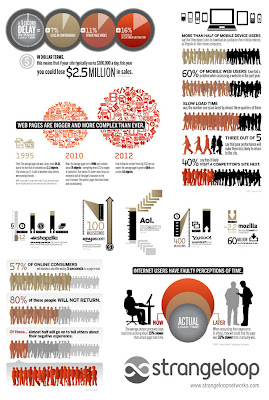
Speed is a bit of an obsession for most web users. We fret over our Internet connections’ and mobile connections’ perceived slowness, and we go bananas for a faster web browser.

4/03/2011
Top 5 Facebook Marketing Mistakes Small Businesses Make

This post originally appeared on the American Express OPEN Forum, where Mashable regularly contributes articles about leveraging social media and technology in small business.
While Facebook marketing is on the rise among small businesses, many are still struggling to master the basics.
“Many people have difficulty with just the basic Page set up,” says social media marketing consultant Nicole Krug. “For example, I still see people setting up their business as a profile page instead of a business Page. I have other clients who jumped into Groups when they came out and have divided their fan base.”
Here are five more common Facebook marketing mistakes to avoid:
1. Broadcasting
Ask any social marketing consultant what the number-one no-no is on Facebook, and he’ll likely tell you it’s “broadcasting” your messages instead of providing fans with relevant content and engaging on an continual basis.
“With Facebook, marketers of any size can do effective, word-of-mouth marketing at scale for the very first time. But Facebook is all about authenticity, so if your company is not being authentic or engaging with customers in a way that feels genuine, the community will see right through it,” says Facebook spokeswoman Annie Ta.
Peter Shankman, social media consultant, entrepreneur and author of “Customer Service: New Rules for a Social Media World,” agrees.
“Your job is to interact, not just to broadcast,” says Shankman. “Fans are looking for a reason to connect with you, and they’re showing you that by clicking ‘Like.’ Your job is to give them a reason to stay.”
According to Andy Smith, co-author of “The Dragonfly Effect: Quick, Effective and Powerful Ways to Use Social Media to Drive Social Change,” many businesses immediately ask how Facebook is going to make them money and have that be the focus, as opposed to trying to engage customers and provide a meaningful, authentic online experience. “Marketers need to recognize that people go to Facebook to make a connection or feel like part of a community,” says Smith.
2. Not Investing Adequate Time
Another common mistake is underestimating the amount of time a successful Facebook strategy entails. Many social media consultants report seeing a pervasive “set it and forget it” mentality among small businesses.
“Some small business owners are under the impression that if they set up a Page on Facebook, that’s all they have to do. They think people will just naturally come and want to be a fan of their product or service,” says Taylor Pratt of Raven Internet Marketing Tools. “But it takes much more of a commitment than that.”
It’s not just fan growth that will suffer from this approach — it may also hurt your relationships with existing fans, particularly customers who have come to expect timely responses to their posts and queries.
“Unlike traditional advertising methods such as a radio spot or a Yellow Pages listing, you can’t just create a Facebook Page and just let it run its course,” says Alex Levine, a social media strategist at Paco Communications. “Creating a Facebook Page is the first of many steps, but the Page needs to be updated and monitored constantly.”
3. Being Boring or Predictable
When they’re thinking about marketing, some business owners forget that Facebook is a social place where people share things they find funny, interesting or useful with their friends. Think about what kind of content your fans would actually want to share when planning your posts.
Shankman also cautions against becoming too predictable. “Status updates by themselves get boring. But then again, so do photos, videos and multimedia as a whole. Your job is to mix it up. The moment you become predictable, boring or annoying, they’ll hide you from their feed. So keep it varied and personal — a video here, a photo here, a tag of one of your fans here.”
Creating too much “filler” content by auto-publishing content from your blog or Twitter feed can also derail your efforts. Joseph Manna, community manager at Infusionsoft, recommends using Facebook’s native publishing tools to gain the most benefit from Facebook.
“Whatever you do, DON’T automate everything,” says Manna. “It’s nice to ‘set and forget,’ but the risk is two-fold: publishing systems sometimes have issues, and Facebook places low-priority on auto-published content.”
4. Failing to Learn About Facebook Mechanics and Tools
Since Facebook is a relatively new medium, some businesses have yet to explore all its functionality and they’re missing out on creating an optimal brand experience.
“Many small businesses do not take advantage of the tools to introduce themselves to the Facebook audience,” says Krug. “For example, the ‘Info’ tab is rarely utilized well, and very few small businesses [create] a custom welcome page.”
Krug also sees frequent mistakes around one of the most basic elements of Facebook presence: the profile image. “Most companies upload a version of their logo, but the resulting thumbnail image that shows up in news feeds often only captures a few letters in the middle of their logo — this partial, meaningless image is then how they’re branded throughout Facebook,” says Krug.
Facebook Insights, Facebook’s built-in analytics system, is also often overlooked, and with it the opportunity to analyze post-performance to see what types of content gets the most engagement.
5. Violating Facebook’s Terms
Not only is it critical to know how Facebook works and what tools are available, it’s also important to know the rules of the road — something that many businesses miss.
“Every day I see organizations endangering the communities they are growing by violating the terms they agreed to when their Facebook presence was created,” says small business marketing consultant Lisa Jenkins.
What are the most common violations? Some build a community on a personal page instead of a proper Facebook Page. Others fail to abide by Facebook’s rules around running contests. And don’t even think about “tagging” people who are in an image without their permission.
“Tagging people to get their attention is not only a violation of Terms but can be reported by those you are tagging as abusive behavior on your part — which brings your violation to Facebook’s attention and opens your Page’s content to review,” warns Jenkins.
To avoid these common mistakes, invest time in learning about the Facebook platform, educate yourself on how to build and sustain an audience, and don’t forget to engage with people like you do in real life.
“What sets small businesses apart from large companies is their ability to make personal connections with customers,” says Ben Nesvig of FuzedMarketing. “They tend to forget this when they join Facebook, yet it’s their biggest strength and asset.”
Google rinde homenaje al helado sundae

Hace 119 años el joven Chester Platt la pidió por primera vez en una heladería de la ciudad de Ithaca. Google se pone dulce. El buscador más grande e importante de Internet dejó atrás por un momento los homenajes a los grandes científicos y literatos y esta vez decidió recordar el 119 aniversario de la creación del helado sundae en EE UU.
Quizá acorde a la cada vez más cerca temporada veraniega en el hemisferio norte, Google cambió su clásico doodle para mostrar una imagen en donde un helado con doble bola provoca a millones de internautas.
El más clásico de los helados está compuesto, por lo general, por una bola de cremoso helado cubierta con jarabe de cerezas, fresa, o fudge de chocolate.
En 1992 la cadena de comida rápida McDonalds lo incluyó en su carta de postres y logró que el postre adquiriera resonancia mundial.
Subscribe to:
Posts (Atom)